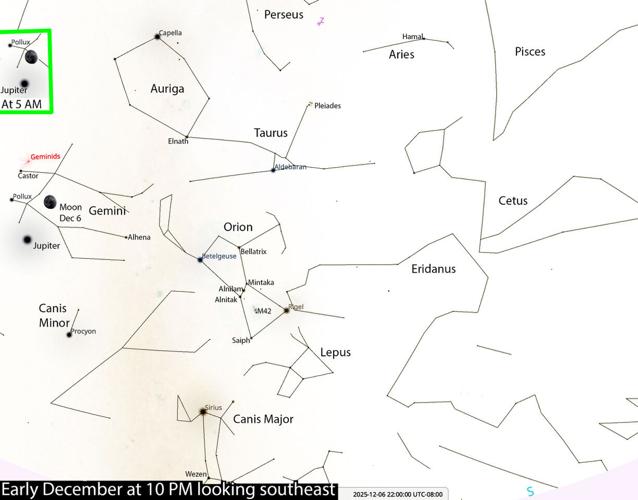
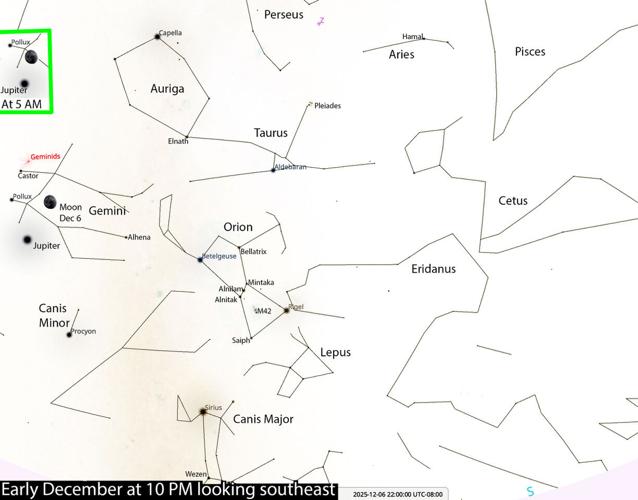
Tonight, the waning gibbous moon will be near Jupiter and Gemini's brightest star, Pollux, to form an isosceles triangle with Pollux at the top vertex as they rise in the east at about 8 p.m.
As the night progresses, the moon will draw closer to Jupiter and by an hour before sunrise tomorrow morning, the triangle will have shrunk considerably with the moon almost in between Jupiter and Pollux. The triangle will again be an isosceles but the moon will now be at the top vertex and you'll be able to fit either the moon and Jupiter or the moon and Pollux within the same field of view of your binoculars.
kAm~ E96 ?:89E @7 s64] `b^`c[ v6>:?: H:== 282:? 36 E96 46?E6C @7 2EE6?E:@? H:E9 E96 A62< @7 E96 v6>:?:5 >6E6@C D9@H6C] %96 v6>:?:5D 2C6 FDF2==J E96 DEC@?86DE >6E6@C D9@H6C @7 E96 J62C H:E9 >6E6@CD C2E6D @7 @G6C `b_ A6C 9@FC @? 2 52C< D<J 72C 7C@> E96 4:EJ] x? q2<6CD7:6=5 H6 4@F=5 D66 23@FE 92=7 E92E 3FE DE:== 2 G6CJ :>AC6DD:G6 d_ E@ f_ A6C 9@FC] %96 >@@? H:== 36 2E H2?:?8 4C6D46?E[ @?=J b_T =:E[ 2?5 ?@E C:D6 F?E:= 2 =:EE=6 27E6C a 2]>]k^Am
kAm%96 v6>:?:5D 2C6 7@C>65 7C@> t2CE9 A=@H:?8 E9C@F89 E96 5FDE EC2:= =67E 369:?5 3J E96 @?46\24E:G6 4@>6E ba__ !926E9@? W?@H 4@?D:56C65 2? 2DE6C@:5X] %96 v6>:?:5D 2C6 2>@?8 E96 D=@H6DE >@G:?8 >6E6@CD @7 E96 J62C[ DEC62<:?8 E9C@F89 E96 2E>@DA96C6 2E @?=J aa >:=6D A6C D64@?5] %96 C25:2?E[ 7C@> H9:49 E96 >6E6@CD 2AA62C E@ 4@>6[ H:== 36 ;FDE 2 =:EE=6 E@ E96 C:89E @7 v6>:?:VD D64@?5 3C:89E6DE DE2C[ r2DE@C[ @? E96 ?:89E @7 E96 A62<]k^Am
kAm%96 =@?86C DEC62<D H:== >@C6 =:<6=J 36 23@FE g_ E@ h_ 568C66D 2H2J 7C@> E96 C25:2?E[ D@ =@@< E@H2C5 pC:6D @C !:D46D 36=@H E96 vC62E $BF2C6 @7 !682DFD] %96 DE2CD @7 !:D46D 2C6 AC@323=J E@@ 5:> E@ D66 7C@> q2<6CD7:6=5 3FE H6 42? D66 E96 3C:89E6C DE2CD @7 !682DFD[ 6G6? H:E9 E96 8=2C6 @7 E96 DEC66E 2?5 3FD:?6DD =:89ED]k^Am
kAm*@FV== H2?E E@ 36 724:?8 E92E 5:C64E:@? @C 6G6? 7FCE96C H6DE 27E6C a 2]>] E@ 92G6 E96 C:D:?8 >@@? 2E J@FC 324<] x7 J@F 5@ H2?E E@ =@@< 2E E96 >@@? :? E96 62C=J >@C?:?8 @7 s64] `c[ J@FV== D66 :E C62==J 4=@D6 E@ E96 3C:89E6DE DE2C @7 ':C8@[ $A:42[ :? E96 62DE] %96JV== 36 ;FDE 2 4@FA=6 @7 <?F4<=6D 2E 2C>VD =6?8E9 2A2CE 7C@> 6249 @E96C 2?5 86E 4=@D6C 2D H6 2AAC@249 DF?C:D6]k^Am
k9bm#646?E 9625=:?6Dk^9bm
kAmx? DA246 C6D62C49 ?6HD[ H6VG6 7:?2==J 56E64E65 =:89E?:?8 @? |2CD 3FE :E H2D?VE 3J D66:?8 7=2D96D @7 =:89E] }p$pVD !6CD6G6C2?46 C@G6C 92D 2 >:4C@A9@?6 @?3@2C5 E@ 492C24E6C:K6 H:?5D 2?5 2E>@DA96C:4 EFC3F=6?46] #6D62C496CD C6\2?2=JK:?8 E96 C64@C5:?8 >256 H96? 2 5FDE 56G:= A2DD65 5:C64E=J @G6C !6CD6G6C2?46 :? $6AE6>36C a_a` 7@F?5 2 4=2AA:?8 D@F?5]k^Am
kAm%96 6=64EC@DE2E:4 DA2C<D @44FC H96? 2:C3@C?6 5FDE 8C2:?D 4@==:56 H:E9 6249 @E96C] %96 >@DE 6?6C86E:4 @7 E96 DA2C<D 2C6 4@>A2C23=6 E@ E96 6?6C8J @7 2 42CVD DA2C< A=F8] %96 DA2C<D AC@5F46 6=64EC@>28?6E:4 :?E6C76C6?46 D9@CE=J 367@C6 E96 4=2AA:?8[ H9:49 :D E96 >2CE:2? 2?2=@8F6 @7 D66:?8 =:89E?:?8 367@C6 962C:?8 E96 E9F?56C]k^Am
kAm|2CDV >:?:\=:89E?:?8 5@6D?VE EC2G6= 72C 3642FD6 @7 |2CDV G6CJ E9:? 2E>@DA96C6 WDFC7246 2:C AC6DDFC6 :D =6DD E92? `T @7 t2CE9VD 2E D62 =6G6=X 2?5 E96 9:89 A6C46?E286 @7 42C3@? 5:@I:56] ~? E96 @E96C 92?5[ E96 D2>6 4@?5:E:@?D 4C62E6 2 >F49 =@H6C E9C6D9@=5 E@ AC@5F46 E96 DA2C<D E92? @? t2CE9[ 2 E9C6D9@=5 a__ E:>6D =@H6C E92? @? t2CE9]k^Am
kAm%96 DA2C<D 96=A 7@C> E96 9J5C@86? A6C@I:56 2?5 A6C49=@C2E6 D2=ED E92E 2C6 C6DA@?D:3=6 7@C 56DEC@J:?8 @C82?:4 >@=64F=6D 2E E96 DFC7246] p?J >:4C@36D @C >:4C@3:2= C6>2:?D 7C@> A2DE =:76 H:== @?=J 6I:DE 3FC:65 5@H? 566A :? E96 D@:= 2H2J 7C@> E96 DFC7246 5:D:?764E2?ED]k^Am
kAm%96 DA2C<D >2J 6IA=2:? H9J E96 @E96C }p$p C@G6C[ rFC:@D:EJ[ 92D 56E64E65 H9:77D @7 >6E92?6 2E E96 DFC7246 H9:=6 t$pVD %C246 v2D ~C3:E6C D2E6==:E6 92D 72:=65 E@ 7:?5 2?J >6E92?6 :? E96 2E>@DA96C6] %96 DA2C<D >:89E 52>286 D6?D:E:G6 6BF:A>6?E D6?E E@ |2CD :? E96 7FEFC6 E92E :D?VE AC@A6C=J D9:6=565 2?5 E96 DA2C<D >:89E A=2J 2 C@=6 :? 96=A:?8 86E E96 5FDE 2:C3@C?6 2?5 >@G:?8 E@ 4C62E6 E96 =2C86 5FDE DE@C>D E92E D@>6E:>6D 6?8F=7 E96 6?E:C6 A=2?6E] q6H2C6 7FEFC6 2DEC@?2FEDPk^Am
kAmx? @E96C DA246 6IA=@C2E:@? ?6HD[ tFC@A62?D 2C6 D:8?:7:42?E=J 3@@DE:?8 7F?5:?8 @7 E96 tFC@A62? $A246 p86?4JVD D4:6?46 >:DD:@?D 2D E96 &?:E65 $E2E6D D6G6C6=J 4FED 324< @? :ED @H? 7F?5:?8] %9:D 3@@DE H:== 36 5:C64E65 E@H2C5 2? )\C2J @3D6CG2E@CJ E92EV== C6A=246 E96 28:?8 &]$] @?6D 2?5 2 >:DD:@? E@ $2EFC?VD >@@? t?46=25FD] t?46=25FD :D 2 D>2== >@@? H:E9 8C62E 2DEC@3:@=@8J A@DD:3:=:E:6D 3642FD6 :E G6CJ =:<6=J 92D 2? @462? @7 =:BF:5 H2E6C 36=@H :ED :4J 4CFDE]k^Am
kAmtFC@A6 :D AF==:?8 324< 7C@> 7F?5:?8 ;@:?E AC@;64ED H:E9 }p$p WE96 pCE6>:D 2?5 {F?2C v2E6H2J >:DD:@?D 2?5 E96 |2CD $2>A=6 #6EFC?X 3642FD6 @7 E96 8C62E F?46CE2:?E:6D @7 }p$p 7F?5:?8] (6V== 2=D@ AC@323=J D66 r9:?2 AF== 29625 @7 E96 &]$] 2D H6== :? E96 4@>:?8 J62CD 3FE E96JVC6 BF:E6 2 3:E >@C6 D64C6E:G6 23@FE E96:C A=2?D]k^Am
k9bmV$62D@? @7 {:89EVk^9bm
kAm%96 (:==:2> |] %9@>2D !=2?6E2C:F> 2E q2<6CD7:6=5 r@==686 H:== AC6D6?E E96 9@=:52J D9@H Q$62D@? @7 {:89EQ @? %9FCD52J 367@C6 E96 42>AFD 4=@D6D 7@C E96 H:?E6C 3C62<]k^Am
kAm%96 A@AF=2C D9@H 368:?D H:E9 2 D9@CE E@FC @7 E96 6G6?:?8 D<J FD:?8 E96 A=2?6E2C:F>VD v@E@ r9C@?@D DE2C AC@;64E@C 7@==@H65 3J E96 bf\>:?FE6 2==\5@>6 AC6D6?E2E:@? 7C@> {@49 }6DD !C@5F4E:@?D 42==65 Q$62D@? @7 {:89EQ FD:?8 E96 A=2?6E2C:F>VD $A:EK $4:s@>6 AC@;64E@C]k^Am
kAmp=@?8 H:E9 EC24:?8 E96 9:DE@CJ 2?5 56G6=@A>6?E @7 >2?J @7 E96 H@C=5VD >@DE 6?562C:?8 9@=:52J 4FDE@>D[ E96 D9@H 2=D@ =@@<D 2E 2 D6=64E:@? @7 }@CE96C? w6>:DA96C6 H:?E6C 4@?DE6==2E:@?D[ H9J H6 92G6 D62D@?D[ 2?5 E96 A@DD:3=6 2DEC@?@>:42= 6IA=2?2E:@?D 7@C 2 Q$E2C @G6C q6E9=696>Q DF49 2D 4@>6ED[ >6E6@CD[ ?@G26[ DFA6C?@G26 2?5 A=2?6E2CJ 4@?;F?4E:@?D]k^Am
kAms@@CD H:== @A6? 2E f A]>][ H:E9 E96 D9@H CF??:?8 7C@> fib_ E@ h A]>] 2E E96 A=2?6E2C:F>[ H9:49 :D @? E96 D64@?5 7=@@C[ ?@CE9H6DE 6?5 @7 E96 |2E9\$4:6?46 qF:=5:?8[ #@@> ``a @? 42>AFD[ `g_` !2?@C2>2 sC:G6]k^Am
kAmp5>:DD:@? :D S`a[ S`_ 7@C D6?:@CD 2?5 49:=5C6? 286D d E@ `a] %:4<6ED >FDE 36 AFC492D65 :? 25G2?46 2E k2 9C67lQ9EEADi^^G2==:E:I]4@>^A=2?6E2C:F>^Q E2C86ElQ03=2?<QmG2==:E:I]4@>^A=2?6E2C:F>k^2m]k^Am